Fantasies
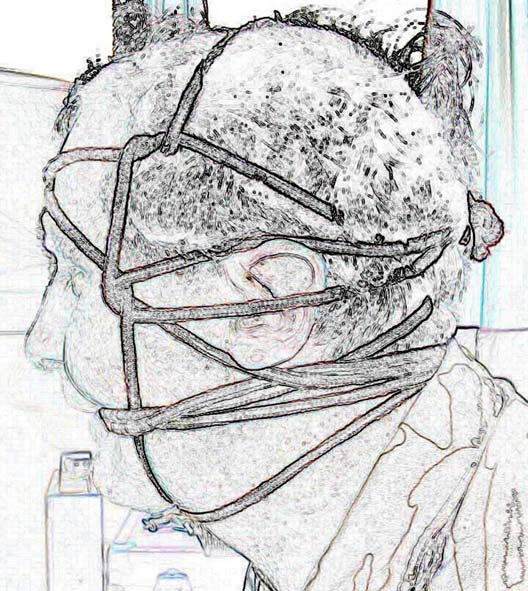
Realities
HOUDINI CONNECTIONS
TOPICS
EIGHT
INFORMATION SHEETS
1
= GAGS
first
published by 'Fetters' 1980
Revised March 2011
Like all other types of restraint, mouth stuffers and covers are mainly a matter of personal capacity - and dare one say - taste!
Whatever the name of your particular game, both physically and psychologically any stuffer, mouth-cover muzzle or head harness can create effects which may be either exhilarating or devastating.
To surrender control of verbal communication is a supreme act of submission. The physical intrusion of something into the mouth can be a traumatic experience - but it can also be a "release", because this allows the gagged person to respond vocally in a more extravagant way than usual. Without disturbing the controller or distressing the neighbours, an efficient gag offers the luxury of a good healthy shout and scream, which some people find very liberating.
Another attraction is the physical pleasure or relief of biting into something.SAFETY FACTORS:
As verbal communication is more completely stifled, so it becomes more important to monitor the victim carefully. Particular responsibility is demanded when the victim is effectively immobilised as well as silenced.
Choking or gagging on something inserted in the mouth can be unpredictable. In case of an involuntary and uncontrollable reaction, any gag must be easy to remove. As a general principle a gagged person should not be left unsupervised. Particular care should be taken if someone is gagged lying on their back.
Teeth can be a limiting factor. Damage to either teeth or false dentures must be avoided. Pressing the lips too tightly against teeth can often reduce the length of time a willing victim can endure gagging. Also, the distance teeth and jaw will open varies considerably: A wide gag which one person finds quite acceptable may be too much for another (jaws can be dislocated).
Nasal breathing causes strain for many people. Temporary sinus problems or a cold can reduce the capacity of somebody who has previously had no trouble. By breathing deeply and slowly a person can increase his/her ability to endure a situation which may at first seem threatening - but a lot of people are unable to breathe adequately through the nose alone. Gags which allow breathing are generally not as sound-proof - but there are circumstances when a tube gag has additional advantages.
Saliva is another factor to take into account. Some types of gag produce much more saliva than others. This can't always be swallowed, and if the victim is lying face down it can stain bedding or carpets. Alternatively, some gags can make a mouth uncomfortably dry. A soft stuffing such as a knotted scarf can dry the mouth when first applied. Damping the fabric can often be effective.
Dust must also be a consideration if the victim is lying on a carpet or in a dusty environment.
Drugs and gags in particular don't mix. As we've already suggested, the best general rule is - steer clear.HYGIENE:
The sterilising and thorough cleansing of anything used as a gag is imperative. Leather stuffers and gum shields should be used by one person only. Gags which can be soaked in antiseptic fluid offer minimal danger.PRACTICAL ALTERNATIVES:
FIXINGS:
The immediate effect of anything inserted into or covering the mouth is a sense of helplessness - but with experience it becomes obvious that many traditional images of gags, as seen in films and TV are, in fact, ineffective.
The tongue and teeth have considerable power to dislodge a gag. Mobility of the jaw usually allows even the tightest cloth wrap-around gag or adhesive tape to be displaced eventually. Something stuffed into the mouth can often be used to dislodge what is supposed to keep the stuffing in place.
BUCKLES 'D' RINGS OR VELCRO:
Single strap:
Holes in a buckle-strap for gag or head-harness should be no more than half an inch apart. Even so this may not allow for accurate enough adjustment. A soft strap threaded through double 'D' rings is infinitely variable and still perfectly secure.
Straps closed only by Velcro tape can be quite secure especially if the strap doubles back through a loop before Velcro makes contact. However, this can be rubbed loose unless steps are taken to prevent the possibility.Buckle position:
Traditionally gags fasten behind the neck - but a front or side fixing has many advantages. The psychological effect of a buckle actually over the mouth is quite powerful.MOUTH OPEN OR CLOSED:
Held open with either a solid wedge, soft stuffer or solid bung with a breathing/feeding hole - each can provide for different opportunities - but many people find that a wide-open jaw soon begins to ache painfully and swallowing/dribbling become problems.
A closed mouth is less able to create noise, especially if also filled and covered. To clamp the mouth closed requires strapping not only around behind the neck but also from chin over crown of head. This strap may also need to be anchored to prevent the 'victim' rubbing it loose. Locking of such a harness is complicated - but if the victims hands can not reach it, why bother?
Noise reduction:
Another consideration is that even when a mouth is efficiently stuffed and covered, noise and vocal communication remains possible. It is the outside of cheeks and around the larynx which needs to be stifled. Of all the different types listed, it is not until you reach 'muzzles' that the configurations described below give maximum noise reduction.STRAP CONFIGURATIONS:
Single strap fixing:
This is the usual image for any gag - but by flexing the neck and chin considerable strain can be put on the gag-fixing. Unless very tight, fabric can be stretched and a strap dislodged. A very tight fixing may damage the corners of the mouth particularly if strapped across an open mouth.
Strap with attachments:
Something in the mouth attached to a strap is much less easy to work loose - but still the strap may cut the corners of the mouth.
Mouth covers:
Used with any attachment inside the mouth this is more secure and comfortable. if the cover is broad enough it can also reduce the sound from cheeks.
Muzzles:
This is usually shaped to fit under the chin as well as over mouth and cheeks - but requires at least one extra strap over the head (usually plus others to hold these firmly in place). When designed to clamp the mouth closed rather than cover a wedge gag, it can be an almost total silencer'.
Head-harnesses:
When surrounding the head with straps - many different configurations are possible - and these all produce a powerful psychological effect. However, although thick leather and heavy hardware may look more dramatic, it may limit time the harness can be worn. Pressure points around the head/nose/neck are potentially dangerous. A harness that feels unattractively limp and lightweight in the hands, can fit better and feel very powerful when strapped in place. Used in conjunction with a hood or helmet the effect can be particularly intense (However, remember - it must be possible to remove any gag quickly in an emergency).
Incidentally, when a head-harness is being put on, be sure to get it centred correctly to avoid obstructing nasal breathing or pull down on the bridge of the nose.
Bridles:
Traditional strappery for a horse, and used to hold a bit in place and control head movement - perhaps with attached reins, can be very effective in game-playing.
Face covers:
Some head-harnesses have built-in or detachable blindfolds. One aim is to rob the wearer of personality - or make him/her less recognisable.
Blindfolds:
These very useful devices concentrate attention by forcing the wearer to rely on other less well-developed senses (also, making them more helpless).
Obscuring the vision is easy but to produce a totally light-proof simple blindfold requires a well designed shape and perhaps some padding.
But, as BOB WINGATE recently reminded me, there is a danger when putting any pressure on eye-balls. Never a good thing. Most certainly contact lenses should always be taken into account.
Two useful solutions I found for myself were: A) Two pieces of doughnut-shaped foam padding inside a soft covering. This can surround each eye socket, but with no central pressure.
B) Swimming goggles blacked out. These are inexpensive and easy to modify.
Inevitably, single-strap blindfolds can usually be rubbed off the head - if such movement is allowed. So - don't allow it!
Hoods & helmets:
These are a slightly different category and are dealt with in HEADTRIPS (Info. Sheet 8). Used in conjunction with gags many types of soft leather hoods can be very effective. Hoods with mouth openings, through which gags can be inserted, are usually preferable to closed hoods laced over a gag.
Other headgear such as motorcycle helmets can serve to isolate the wearer and increase the sense of helplessness. Sports stores also stock a range of face-guards and protective masks which can be useful to imaginative players.Gasmasks:
These automatically reduce ability to make noise. Used with a snorkel breathing mouth-piece or any 'stuffer' they are a very effective form of gag. However, making a gas-mask impossible to remove by rubbing against a surface can only be achieved by devising a separate series of straps for the back of the mask - or totally immobilising the head.
Gasmasks with latex backs attached can be particularly effective to imprison the head (and also the mind) while inhibiting verbal communication.SHAPES AND SIZES
Ball gags:
A semi-soft ball, depending on its size can fit between the teeth or behind them in the mouth. Ball gags are often pictured on a thong or light chain. As such they're an inexpensive and efficient toy - but they do tend to damage the corners of the mouth. A wider strap is advisable if used for any length of time. You can find suitable balls in toy and pet stores - both are likely to be made from non-toxic materials. The same can not be said of shaped bungs, etc. bought from hardware or motor-supply sources.
A largish ball forced beyond the teeth and into the mouth can be effective (if the ball will come out again without too much dental strain).
A smaller ball completely in the mouth, anchored to a mouth-cover and the mouth clamped closed, has a whole different feel and can be very effective (A squash ball is an ideal size for most people).
A larger soft foam ball, sold in many toy shops and in sports stores (for tennis practice), is an interesting alternative. Squeezed small it will fill a mouth very effectively and can be held in position with just a light strap. It will also absorb and hold a considerable amount of liquid, which can intensify the situation.
Plug gags:
Usually plastic which is less easy to bite into than rubber. Often shaped quite realistically as the head of a penis. The usual aim of plugs is something to suck on, rather than a silencer. With larger or langer plugs, a hole through the middle makes breathing easier.
Wedge gags:
Suitable shapes can be found, but the chemical composition of the material may be questionable. Rubber door-stops in various sizes have been used to great effect when attached to a mouth cover.
The ideal shape is a slice of orange. This can be whittled from wood and covered with leather or rubber (with or without padding).
Wedging only the front centre of the teeth may create dental problems for some people. A wedge which follows the tooth line is safer - and with something added to press down on the tongue, this can be very effective.
For details of a uniquely efficient custom-made combination of gum-shield and wedge, see the Callum Buchanan web page on sports gear modified.
Bar gags:
A traditional gag, used by surgeons before anaesthetics were invented, was a piece of wooden dowel padded with sheepskin and covered with leather. Two leather thongs attached to either end were passed behind the head, wound round the opposite ends of the bar and then fastened behind the head. The rubber bar is also a simple and practical device.
Horse bits:
Actual harness bits come in many shapes and sizes. Pony-size is usually best, and ones with a rubber bar are easier on the teeth. Whether incorporated into a bridle and reins or just used on a single strap, this piece of authentic equipment has a quite unique feeling when used in a Scene.
'O' ring gags:
Although they hold the mouth well open, metal rings (whether covered with leather or not) put all pressure on the side teeth . So any jolt which causes sudden mouth movement could be dangerous.
Some people find an 'O' ring can be turned in the mouth and is therefore ineffective. To prevent this the strap should be at least an inch wide.
Tube gags:
Embedded in a wide mouth-cover, plastic plumbing pipe or rubber hose can make useful breather-gags. The maximum diameter of the pipe is determined by the distance between teeth (or by the object of the exercise). Again, all pressure is on the front-centre teeth so care must be taken. If a stopper the size of the tube's internal diameter can be found, a dual purpose gag can be made. (Liquid intake is discussed on the main GAG'S INDEX PAGE under the heading Drinking Gags.)Snorkle mouth-pieces:
Various shapes and configurations can be adapted as a gag, and can be purchased without embarrassment from most sports stores. On the Strait-acting site (see end of this page) several types are illustrated.
Stuffers (closed mouth):
As distinct from plugs (which hold the mouth open) mouth stuffers enter the mouth and allow the teeth to close - perhaps with the mouth then taped shut, or a strap under the chin to keep the mouth closed. Apart from the pre-formed balls and bungs already mentioned, hand-made soft stuffers are available made from leather, rubber and moulded plastic. Ideally these should be attached to a mouth cover or gag-strap, and it should not be possible to bite through the connecting 'neck'. A mouth-stuffer not attached to an outside cover must be big enough not to swallow.
If this kind of 'stuffer' situation appeals to you, it is worth experimenting to discover the approximate size and capacity of the mouth interior behind the teeth. And, of course, what goes in, it must be possible to come out again without damaging the teeth. Using a thin plastic bag and some small pieces of fabric, allow the corner of the bag into the mouth and then load in fabric until the mouth is tollerably full. Twist the neck of the bag and bite down to mould a shape. The measurement of the circumference and length will give a useful indication of the size you need when making or buying something more permanent.
Inflatable gags:
Psychologically these promise well, but there are several problems. If not strongly inflated it is possible for the teeth to puncture it. If inflated too strongly it can press onto the back of the throat and cause breathing difficulties or even jaw damage. Some people maintain that if an inflatable bladder pops' in the mouth this can cause serious damage to the lungs. Discussions with several doctors have produced conflicting opinions on this point.
Boxer's gum-shields:
A pair of these can be made into a very efficient gag and mouth immobiliser. After being softened in hot water they form a mould giving a plastic casing to the full arc of the teeth (they can only be worn by one person). An upper and lower set of these can then safely be wedged apart because the pressure is equally distributed and thus the teeth protected.
A breather wedge made to fit between two sets of Gum Shields can be excellent for many situations. A mouth clamped closed on Gum Shields is totally immobilised and if cheeks are covered, this makes an almost total silencer.
Outside dildos:
These are very specialised pieces of equipment, used in both heterosexual and homosexual games. Even when not used for penetration, the humiliation of being made to wear it plus the implied threat, make it a powerful device. If it is intended for actual use, the protuberance must be solidly anchored to the mouth-cover and perhaps connected to a stuffer' inside the mouth.
Adhesive tape:
A small piece of tape stuck over the mouth to silence a victim is a film and TV cliché. In reality it is not so simple. Because of the flexibility of the cheeks and jaw the tape must be wide enough, long enough and stuck over the mouth when open to make it truly effective.
Alternatively, the jaw has to be taped upwards before the mouth is covered.
A mouth stuffer used in a taped mouth can be used to push the cover off. Wrapping narrow tape around the head and across the open mouth to hold stuffing in place is effective but can cause the victim to bite into his/her flesh inside the mouth. Fabric based Duct-tape' can be very useful - particularly when wrapped around both the gag-line and from under chin round over the top back of head. Two points to be borne in mind are that removing adhesive tape can be painful and the possible toxicity of industrial tape.
END 1-GAGS original Info sheet2 Chastity Belts
3 Dildos & butt plugs
4 Hospital Restraints
5 Genital Bondage
6 Strait-jackets
7 Bags and Sacks
8 Hoods and Headtrips