SMALL HARDWARE
(See photos later)
Removable anchor points
Tension stretchers
Pear hooks
Chain links
Double-ended trigger hooks
Karabinas,
etc
HOUDINI CONNECTIONS
CHAIN FRAMES
TECHNICAL DETAILS
(under construction)
TECH. SPECIFICATIONS as sent to correspondent (‘Letters from the Fetters Files’)
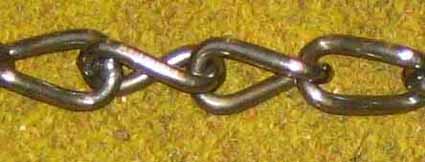
Type of chain depends on budget and availability. Local DIY shops usually stock a small range and sell by the meter; a drum of chain from a wholesaler can be a good investment. Chain links must be welded. Personally, Size I’ve always used is approx 6mm gauge (wire thickness) with links approx 40mm long (1.5 inches). It’s important that the gauge is not too thick or links too short to allow for pear hooks, trigger hooks and screw-links to be attached and unattached easily.
Metal finished of chain can be a matter of taste but does affect the price.
Plated chain is not recommended.
Black finish looks dramatic if the coating is fired-in
rather than sprayed on.
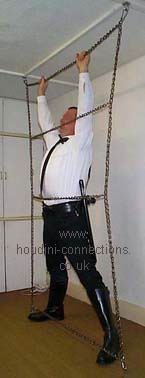
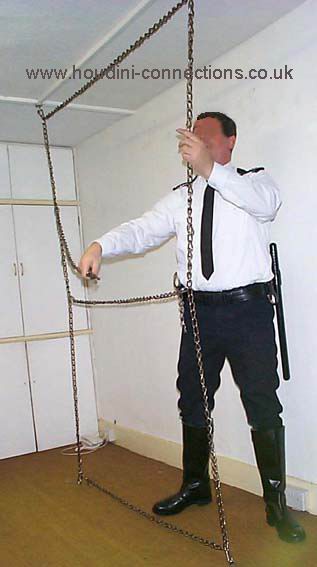
Chain lengths are a matter of ceiling height plus width of frame required. To attached arms spread sideways, wrist-to-wrist is sufficient rather than widening the frame beyond finger-tip to finger-tip.
Generally, two meters wide is enough.
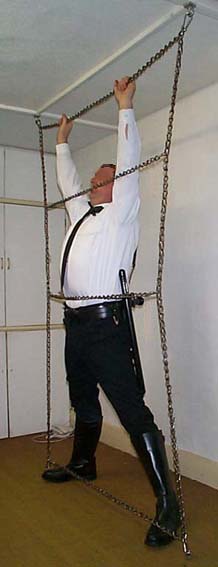
The main chain is a single length twice the height plus twice the required width.
In addition, two separate pieces of chain the exact width are necessary.
A few short lengths for random attaching can come in useful (details later).
Rigging points depend on what sort of ceiling and floor.
Ceiling fixings are what the efficiency of the whole system depends on.
Wood joists drilled right through and long eye-bolts (with metal washers on top-side) are best if you can get above the ceiling (if an attic or under floorboards in the room above).
Ceiling joist may be quite thin if there is no floor above. In an accessible attic, an extra plank of wood can be added above joists between the two fixing bolts to add stability. Any bounce in the ceiling should be checked.
A longer metal bar above ceiling joists can give extra security but is seldom necessary.
With really heavyweight use, there is a possibility that ceiling eye-bolts can bend in towards each other, damaging the plaster around them. I installed a metal bar on the ceiling between these.
For lighter weight use, screw-in eye-bolts (see photo below) might serve in wooden joists as long as they’re not expected to support full bodyweight. Alternatively a metal bar with eye-bolts attached on either end can be screwed with long screws into each joint along the span to distribute weight.
Concrete beams are ideal if they can be drilled into and raw-bolts used.
All ceiling fixings should be checked regularly for any signs of weakening, especially if they are intended to support full bodyweight or heavy jolting.
Floor anchor points can be screw-in eye-hooks if the frame is to remain permanently in place. If removable, it is better to use floor plates which allow the eye-hook to be unscrewed from it. Some such plates are available but not easy to find. A nut welded to the underside of a small drilled metal plate (see photo) and this screwed to the floor is something any small metalworker can knock up.
To leave an eye-hook protruding from the floor when the chain has been dismantled can be dangerous.
General rigging depends on personal requirements. The main square of chain when first installed, is best measured from one floor point up to the ceiling and there attached with a pear hook, leaving the chain end touching but not attached to the floor.
The chain should then be attached as tight as possible to the second ceiling hook. The chain now hanging should next be attached to the floor hook below it. Finally, the chain must now be attached to the first floor anchor-point together with the hanging chain, perhaps using more than one pear-hook.
For rigidity, the two horizontal chains between the vertical chains are what makes the square frame taut. These are added after the main chain is secured to all four points - pulling the upright chains together to remove as much slack as possible.
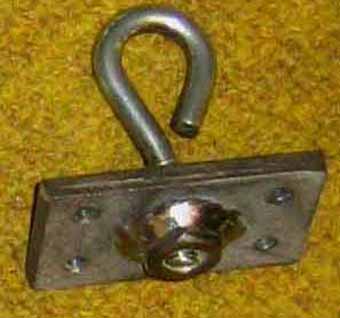
Plate fixed to floor under carpet, eye-hook unscrews
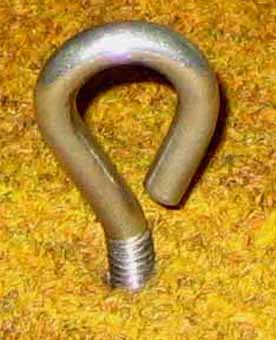
Four ceiling points can allow a chain to be strung between all four.
This offers great flexibility, giving attachment points anywhere around the perimeter, or to added chains across the high-level frame.
SMALL HARDWARE
1
2
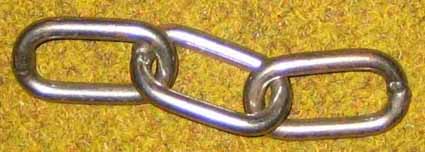
1. Chain - long link
2. Chain - twist link
3. Long ceiling bolt through joist
4. Floor eye screwed into plate
5. Floor eye un-screwed
6. Pear hook for general fixing
7. Chain link for finger-proof fixing
8.
Double trigger hook
9.
Screw eye
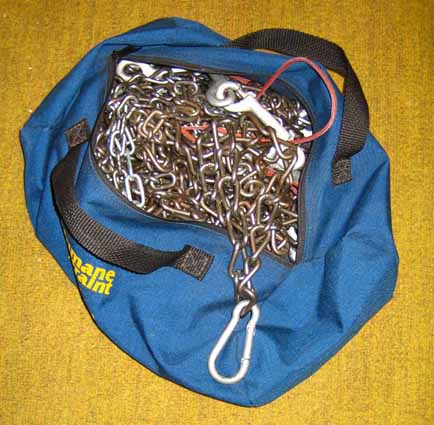
Chain frame packed away
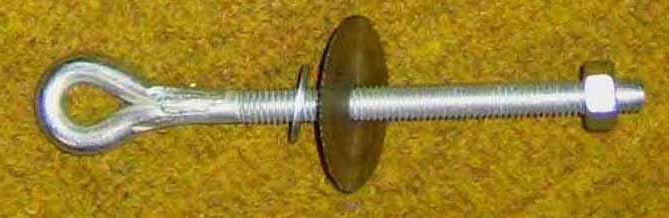 3 4
3 4 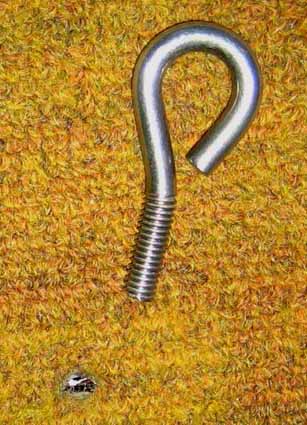 5
5 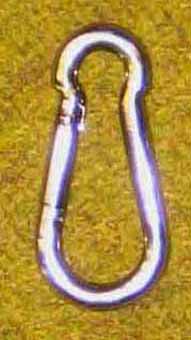 6
6
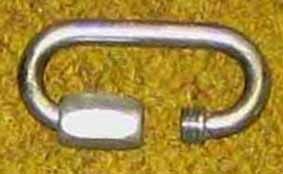 7
7 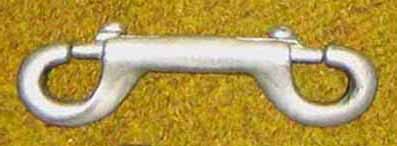 8
8 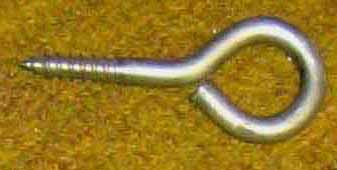 9
9
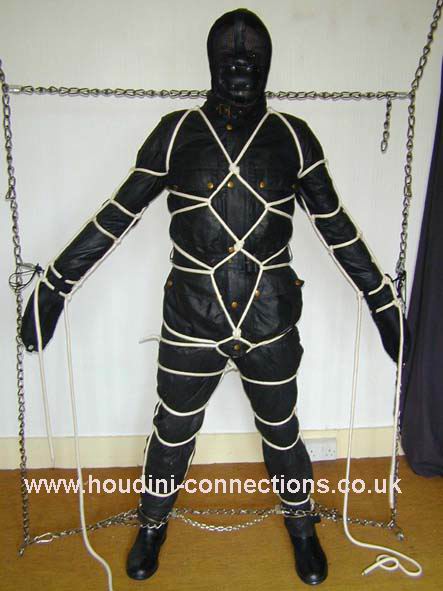
Photo session plan
Routine for documenting an elaborate rope tie over motorcycle gear.
The ‘victim’ already blindfolded, hobbled and hands cuffed behind back.
- Chain frame pre-prepared with clips and short chains.
- First, quickly put chain around waist+arms and fix to waist-high horizontal.
- Then clip ankle manacles to floor level chain so boots are secured apart.
- Next add chain around collar of bike jacket.
- Anchored, immobilised and sightless, time can be taken to pull elbows together behind back and lock off to waist-high horizontal before removing handcuffs.
- Now mitts can be put on against resistance - with laces to prevent them being pulled off again - before rope is attached around each wrist separately.
- Wrists ropes long enough to thread each through upright chains and make off temporarily - before releasing elbows, then waist chain.
- With ankles and neck already anchored, arms can be dragged sideways one at a time, keeping well out of reach of other hand (already roped to opposite side upright).
- Each wrist can then be roped securely to chain uprights ...
Now total roping of the body can begin.
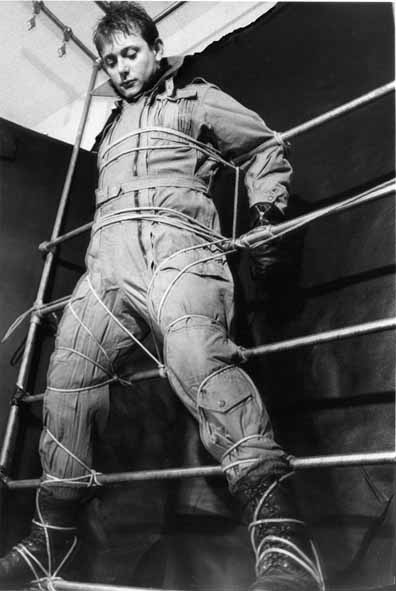
SOLID FRAME
Easy to erect small-scale joint-and-pipe system can provide a more solid and permanent arrangement. Check out KeyKlamp
DESCRIPTION FROM ANOTHER STORY ...
Once the parameters of our session have been agreed, we usually co-operate while climbing into whatever gear has been chosen. That’s our usual routine; no resistance until some form of initial ‘handicap’ is in place, then we are free to be as uncooperative as opportunity allows from then on.
Having kitted me out to his satisfaction ... on this occasion he used handcuffs behind my back and an efficient padded blindfold. “To avoid any nonsense” he explained, adding some sort of ankle hobbles. I couldn't see, but knew they weren’t leg-irons because regular leg-irons are too small to close around bike boots. As the second ankle lock clicked shut I sensed him stand up.
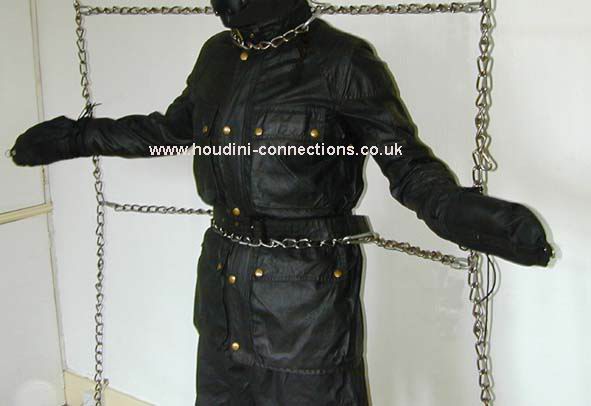
“Why? he said, ‘are you thinking of putting up a fight?” and before I’d even considered what options might be open to me, I was suddenly swung round and pushed back against our chain-frame set-up.
This simple installation consists of two useful upright chains plus tight chain strung between at ceiling and ankle height plus two horizontal chains. These are adjustable in height, but today I soon knew where each chain was, because a quick rope around my waist and arms pinned me there and going nowhere ... while the chain of the leg Irons was clipped to the bottom chain before I knew what was happening ... before another short rope around the high collar of my waxed jacket brought the back of my neck neatly against the higher horizontal. I could see none of this coming, because of the blindfold.
FINALLY - ANOTHER DESCRIPTION OF A CHAIN FRAME IN USE
Hi Danny,
...
... more about self-applied bondage situations:
The guy from Liverpool I told you about, is very ingenious when tying or strapping himself into complicated self-applied restraint. But, of course, he always has to leave an escape route because he only ever plays solo. We’ve exchanged a few ideas - and he was thinking about rigging up a chain-frame for himself, so came down to visit for the weekend recently.
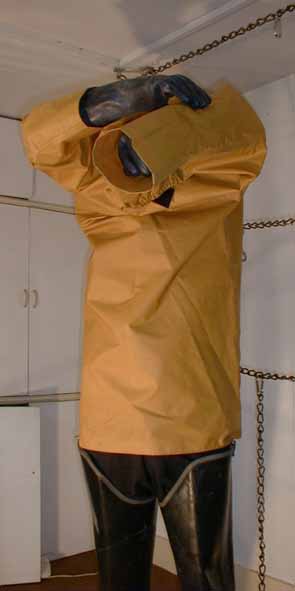
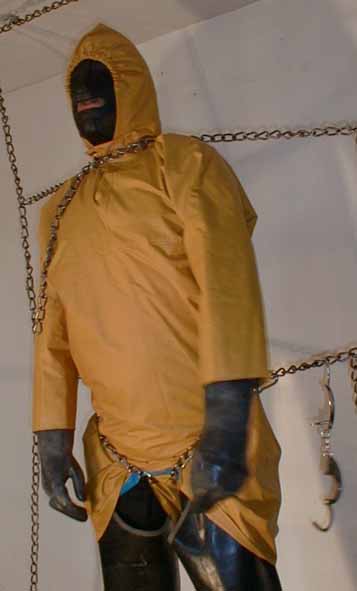
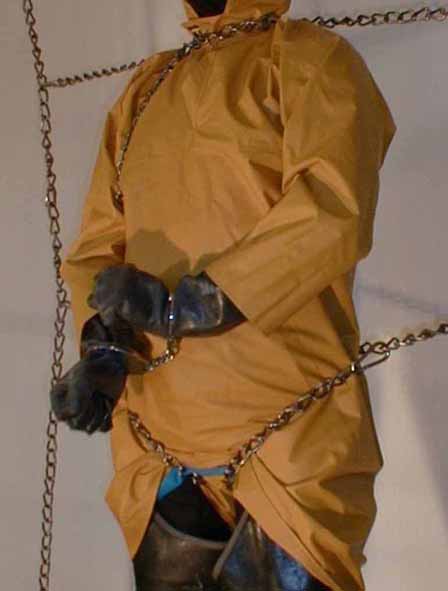
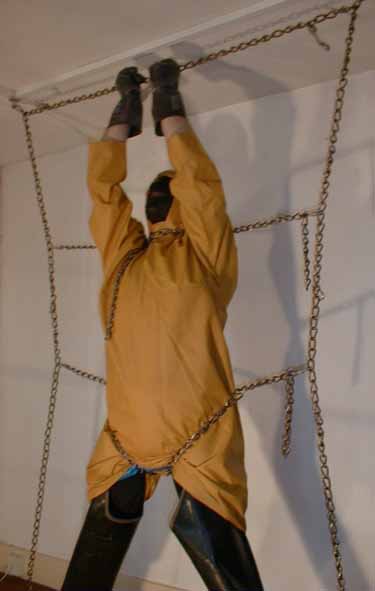
He brought with him a tough yellow oilskin fishing smock and waders which he liked to truss himself up in. For an experimental session he also wore a mesh hood so I could take photos and him not be recognised.
I suggested he should work out how to attach himself progressively more securely to the chain frame - just to experiment. He used short lengths of chain and spring clips to attach himself, first through the crotch and back to the waist chain of the frame. When this was tightened to his satisfaction, he then added chain around the neck. This limited movement and his ability to see what he could achieve next. We discussed whether this had been a wise move.
Although at this point he could easily get out, he had a good old rattle around on the frame to test it. When I suggested making his situation more challenging, he was game for it - so I offered him thick industrial rubber gloves.
He'd previously written to me about his ability to get himself into and out of handcuffs. So when the gloves were on, I asked if these would prevent him from getting into cuffs. He accepted the challenge.
With neck still fixed to the frame and thick gloves on, he not only managed to close the two cuffs - but popped the key into his mouth - his usual routine when cuffing himself when alone. Luckily, the hood had a mouth hole. As the key disappeared, I asked if he'd ever swallowed a key - and he managed to say 'No' (around the key, which had a long piece of string attached to it so he could more easily keep track of it).
When asked whether he now wanted to show me how he unlocked the cuffs using his mouth ... or try making his eventual escape even more difficult ... he was tempted. So I offered him a pear-hook with a strong spring clip and suggested he put it around the centre chain of the cuffs.
He asked why - but I just said ‘Just do it’ - and he did after a struggle because of the thick rubber gloves. I then suggested he should try and hook it round the top horizontal chain of the frame.
He was up for the challenge, and determined to achieve it. It took time before his cuffed and gloved hands managed to get the spring clip through a chain link. He was out of breath, especially with the key in his mouth and arms now fixed quite high above his head.
I asked if he thought he would be able to re-open the clip again - and I knew from the look on his face behind the mesh that he wasn't sure ... but would be game to try.
In our correspondence, we'd also discussed the advantages of having somebody present when experimenting with new self-release situations. Because I was around, he could take risks he'd not taken before. So I then reminded him that he'd once written to me about the possibility of having a 'final strap' closer', the only way he could experience being restrained and totally unable to escape - a situation he'd never experienced - never taken that risk.
When I suggested that this might be a good time to take that risk, he looked suspicious. But when I told him to try moving his legs as far apart as he could - he complied. This stretched his arms tighter above him. I asked if he thought he could still release the handcuff clip from that position. His face told me that he knew he couldn't, but his mouth remained shut.
Picking up a leather strap I asked "Final strap time?"
When I stooped to strap one of his boots to the outside of the chain frame - he put up no resistence and didn't move the other boot inwards - so I strapped the second boot to the other edge of the frame, stood up and looked him in the face.
He knew he was well and truly fixed.
"Want to spend a bit of time like that?" I asked. He gave the frame a couple of experimental tugs, assessing possibilities for finding a way out. Then he nodded "Yes" to my question.
I knew he often liked to gag himself before his self-applied restraint sessions, so I picked up a gag and looked at him questioningly. He wasn't sure and I though he might refuse - but then the handcuff key suddenly appeared between his lips. It was an offer I didn't refuse. Taking possession of the cuff key, I applied an efficient plug gag.
When I then told him he was there for an hour unless he could find a way out, he at first looked apprehensive - and then smiled behind the mesh face covering and nodded.
Well, he certainly had a good shot at trying to wreck the chain-frame - and he’s a tough bugger - but he was still there when I eventually offered to release him after a sweating and straining hour. When I asked if he wanted out, he nodded ‘Yes’, so I unstrapped his ankles and then ungagged him.
Able to stand up straight at last, he was seriously knackered. He admitted it had been a real strain on his arms, legs and back.
I asked if he'd started to work out ways of using the chain-frame for self-applied restraint sessions, and he replied, "That's all I've been thinking about for the past fucking hour and I've already cum twice!"
"Well then," I said, "you'd better work out how you're going to release the cuffs from that spring clip - or you'll be l staying there for another hour".
He opened his mouth to object - and I put the key into it.
"Don't drop it, or you'll be there for more than an hour." I said - and went to make a cup of tea.
But I did leave the monitor camera running so I could watch from the other room as he writhed and struggled hard against the frame.
Trying to un-hook the tough spring clip above his head made him more and more frustrated. But eventually he managed it - and took time to rest his arms. He then had to set about trying to get the little cuff key from his mouth into one of the key holes in spite of bulky rubber around his wrists. I was amazed that he never dropped the key. In a self-applied situation while alone, this would have been very dangerous. But he had worked on his escape skills, and I realised that the piece of string on the little key was essential to his plan. It took a seriously concentrated half hour before he managed to open one cuff. After that release, was easy
- BUT -
Even when he was at last able to peel off the soggy rubber gloves, he didn't un-chain his hips. He stood there against the frame speculating on different positions for his arms. He re-spread his legs and experimented with chain and pear-hooks conveniently left hanging around the frame. He tethered his knees tightly towards the side chains. He then bent forward to see if he might secure his well-spread ankles without assistance - and whether he could eventually invent a way to hook his wrists to the ankle-level chain either at the centre or even with arms separated wide on either side.
It was another hour before be climbed out of his oilskins and waders, took a shower and joined me in the kitchen.
During the weekend he had more opportunities to experiment, with a willing helper to assist only if he got himself into difficulties.
As soon as he got home to Liverpool, he made up a chain frame for himself.
Back to HOME PAGE