Museum exhibit
genuine or fake?

HOUDINI CONNECTIONS
CHASTITY
BELTS
NEWSPAPER ARTICLE
E.
Typical reportage on the theme.
FROM DAILY EXPRESS Thurs 27th June ‘96
EVERYTHING YOU WANTED TO KNOW ABOUT CHASTITY BELTS
but were afraid to ask
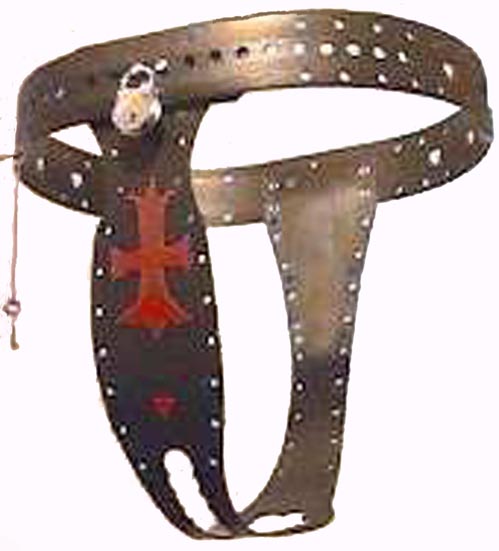
In the stories of old, when a knight won his spurs he galloped off to the Crusades - and locked up his wife in a chastity belt. Or so we were always taught.No school visit to a castle dungeon was complete without a glimpse of a gruesome girdle. Usually, it was next to the scold's bridle, the tongue restraint for the over-chatty. Together, they formed the ultimate Awful Warning to women not to love too recklessly or talk too much.
But now, two scholars are racing to write books dismissing chastity belts as a medieval myth. Museums are quietly removing them from display as red-faced curators admit that the crude, spiked belts are Victorian forgeries for dirty old men.
Many deny they were ever displayed. The British Museum won't confirm that it recently removed two specimens. “We only had one, and that was in our 1990 exhibition of forgeries,” says spokeswoman Adrienne Ridsdale.
So, are the museums giving way to political correctness? Mark Girourard author of Chivalry And The English Gentleman, thinks belts probably did exist in Crusader times. “I should think some were made in the Middle Ages,” he says. "Chastity belts were all that Victorian chivalry didn't stand for: gentlemen put women on pedestals. But I expect belts of that time were faked for pornographers."
Collector Sir Humphrey Wakefield says he'll vouch for his 15th century German chastity belt, “Until Rembrandt is found not to be Rembrandt”. He bought his belt in Ireland and says: "It's cunningly designed so that even if you could get into it, you couldn't get out." He won't be letting his daughter try it on again, however - she broke it.
Juleps Bryan, director of collections at English Heritage, can't recall a chastity belt in the national collection, but would display one even if it were a fraud. “It's still a historical object, a dark underside of the Victorian Gothic revival,” he says.
Chastity belts have always been impractical. How would the woman cope in the bathroom? And if her husband was killed abroad, with the key, how would she get out?
The London Dungeon, which still displays a spiked chastity belt, has the answer. “Wives often sought the aid of locksmiths to release them, which explains the increase in the name Smith,” says spokesman Feisal Khalif.
An expert in the Crusades period, Dr. Susan Edgington, senior lecturer at Huntingdonshire Region College, thinks the idea of women as man hunting adulteresses, or shrinking violets needing protection, is nonsense.
“Often the Crusaders entrusted their lands to their wives,” she says. “You get women like William the Conqueror’s daughter Adela, a much stronger personality than her husband Stephen. He skulked home from he Crusades and she nagged him to go back. She wouldn’t have been .locked up in a chastity belt.”
Also, she points out, knights hoped to leave their wife pregnant to provide an heir. A locked belt would endanger the birth.
Why were chastity belts invented? James Brundage, a medieval sex expert at Kansas University, thinks that a medieval chastity belt was only used by “… a handful of prisoners who .wore them for protection against licentious warders”. Professor Felicity Riddy of York University thinks they .may have been fitted by prison authorities, if at all, as a contraceptive. “You couldn't be hanged if you were pregnant.”
She thinks that the idea is a huge medieval urban myth which, by the 1700s, was taken seriously.
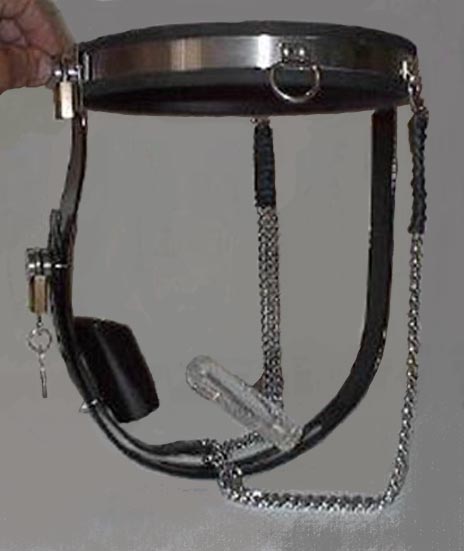
Nicholas McCullough Sotheby's armour specialist sold two chastity belts in Denmark last year for £1500. “They were relatively plain iron frames with a bizarre serrated opening at the front and rear. Horrible things, made for dirty old men. These .days, sado masochists seem to love them,” he says.They're still being made today. Gail McConaghie, of the Medieval Magick shop in London, says: “I've made fabric chastity belts - simplistic knickers based on old pictures with fake padlocks to cover yourself.”
One shop said: “We stopped stocking them because people kept losing the keys.”
Michael Sullivan of The Girdler’s Company, welcomes them. He says they may be a fashion accessory for fathers worried about their daughter.
“Chastity begins at home” is his motto. “Will they be sold in the Sock Shop?” he asks.
Return to CHASTITY INDEX or PHOTO GALLERY